
Summertime in Milwaukee can be idyllic, particularly if you take advantage of the city’s many green spaces. From the sprawling lakefront to a confluence of thriving rivers and over 15,000 acres of parks, it’s no wonder Milwaukee County is recognized for its natural beauty. These spaces are shared not only by Milwaukee’s human residents, but a surprisingly diverse array of native raptors.
Most raptors spend our warmest season rearing recently fledged chicks, learning the ropes of survival, or staying cool in the sometimes sweltering Wisconsin heat. Regardless of where you go to enjoy a sunny day, you are bound to encounter one of these charismatic predators.
Parks & Natural Areas
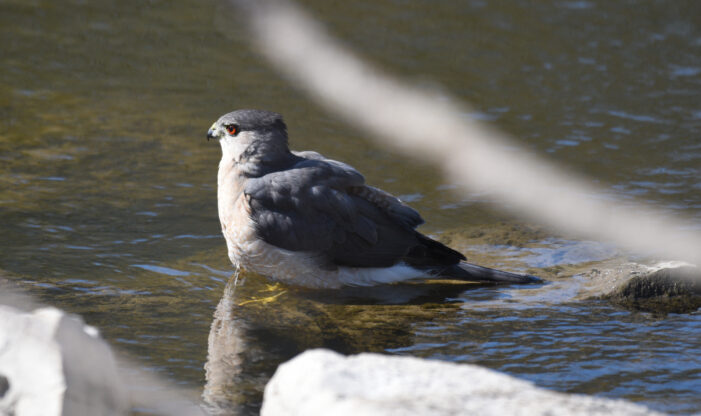
On a Sunday morning stroll through the ravine forests of Schlitz Audubon or Lake Park, you may catch a flash of grey and white bolting through the trees— a small hawk with a long, banded tail. Perhaps it darts over the Visitor Center or perches near Lion Bridges at the park, a feathered prize in its talons. Often mistaken for Red-tailed Hawks or falcons, Cooper’s Hawks are becoming increasingly common in cities. These slender hawks are adapted for hunting in structurally complex habitats, and urban environments can offer similar complexity with the added benefit of abundant small prey birds. Learning how to hunt can be a clumsy challenge for the newly fledged chicks. Luckily, parents continue to provide food for up to seven weeks after their young have left the nest. You may observe siblings perching together through the summer, mimicking their parents, or even attempting to cooperatively hunt.
While attending one of the Center’s popular Owl Prowls or enjoying the quiet after an evening of live music at Humboldt Park, you may find yourself audience to a different kind of chorus: the high-pitched whinny of an Eastern Screech Owl. With one of the broadest ecological niches of any owl, these crepuscular creatures are surprisingly common in wooded lots and urban parks. Their secretive nature and excellent camouflage mean we simply don’t see them as often as we hear their twilight serenades.
Densely feathered owls avoid summer’s heat by keeping their movements minimal during the day, perching beneath foliage nearest a tree trunk, or remaining out of sight entirely in a comfortable cavity. If they get too warm, they may begin “gular fluttering” by rapidly moving their throat muscles to cycle hot air out of their mouth, much like the panting of a dog.
Local Waterways
The city’s waterways provide a refreshing reprieve from the heat for raptors. Some take a quick bath, sitting with wings and feathers puffed out to increase evaporative cooling. Others take their time standing in ankle-deep water, letting the heat flow from their feet into the cool water.
As you hike or kayak down the Milwaukee River, past Estabrook or Riverside Park, keep an eye out for Milwaukee’s growing Bald Eagle population. With the Center’s proximity to the river, you may also spot these striking raptors during your next visit. Though reaching full size at three months, first-year Bald Eagles appear dark brown from head to toe. After fledging around late June to early July, they increasingly hunt independently using skills developed by observing their parents and through trial-and-error. This means you may see a juvenile eagle scavenging along the shoreline or diving into the water only to come up empty-taloned.
Along the trails at County Grounds, you may be lucky enough to spot a resident of the nearby Menomonee River Parkway—an even more experienced fisher: the Osprey. While Bald Eagles skim the water’s surface for fish, Osprey dive fully in, often submerging their bodies completely. These sizable birds have a similar wingspan to the Bald Eagle, but a prominent M-shape to their outstretched wings, a dark patch of feathers at the wrists, and a white underbelly. Osprey pairs spend most of the summer raising young before departing in August for an impressive journey as far south as Chile. Atop a platform nest of sticks, the female uses her wings to shade her chicks from the hot sun while the male delivers a diet of almost exclusively fish.
From your panorama view of the city at Lakeshore State Park, pull out your binoculars and you may observe a Peregrine Falcon diving from the U.S. Bank Center. In Southeastern Wisconsin, where we have few bluffs, the tallest buildings of our skyline provide ideal nesting sites for these energetic raptors. Soon after fledging, young falcons spend their first few weeks building the stamina, coordination, and agility needed for hunting other birds. Adults stop bringing food directly to the nest and begin turning mealtime into a lesson. They fly past with prey to entice their hungry young into pursuit or drop food for the juveniles to catch midair, helping them develop diving and snatching skills. Milwaukee is a major hub for Wisconsin’s growing Peregrine Falcon population, with over 465 chicks hatched since 1992 thanks to conservation efforts by We Energies.
As summer reaches its end, the Lake Michigan shoreline becomes a bustling superhighway for migrating birds. In September, while the air is still warm and circulating, watch for Broad-winged Hawks soaring overhead along the shorelines of Schlitz Audubon, Doctor’s Park, or Bradford Beach. Though secretive throughout most of the year, during migration they form enormous flocks known as “kettles” and utilize warm air thermals to carry them south. Climb the Center’s Observation Tower for a better look at these and other migrating raptors.
Beyond Milwaukee
For many of us, summer weekends offer the opportunity for day trips or camping excursions. Be sure to keep an eye on the southeastern habitats you travel through—raptors are everywhere! Red-tailed Hawks can be seen perched off the highway; their upright posture, white belly, and belt of dark feathers are helpful traits to look for. As you drive through rural Wisconsin and its rich farmland, watch for one of the smallest, most colorful raptors: the American Kestrel. These petite falcons thrive in grasslands and open agricultural areas. Their summertime diet shifts almost entirely to insects like grasshoppers, cicadas, and dragonflies, an ample food source for their chicks. About the size of a robin, they perch on fence posts and powerlines as they bob their heads and pump their tails—a behavior unique to this species.
Another lesser-known raptor also prowls these grassy habitats: the Northern Harrier. These small, slender raptors have a wingspan of three to four feet. The wind carries their buoyant bodies as they fly low and forage over tall grasses. With a facial disc similar to that of an owl, they rely heavily on auditory cues to capture small mammals like field mice and voles.
If your ideal summer weekend is camping with friends and family, listen for Red-shouldered Hawks in densely forested habitats, such as those of the Kettle Moraine. Despite their elusive nature, they are one of the noisiest raptors, uttering a repetitive, high-pitched “kee-aah” call. Their cries can be heard for miles, especially in woodlands or near marshy areas, where they defend their territory. Should you wake in the night to a riotous duet of cackles and “who cooks for you calls,” stay awake a little longer to enjoy the midnight conversation of a Barred Owl pair. This species occupies an almost identical ecological niche to the Red-shouldered Hawk—however, one species is primarily active during the day while the other prefers nighttime.
Southeastern Wisconsin is home to many raptor species, and the landscapes found at the Center offer excellent summer habitat for these birds to roam, feed their families, and learn how to survive. Schlitz Audubon is grateful to be part of Milwaukee’s thriving network of green spaces and waterways that provide an enriching summer experience for our community’s residents, human and wildlife alike.
Sources: