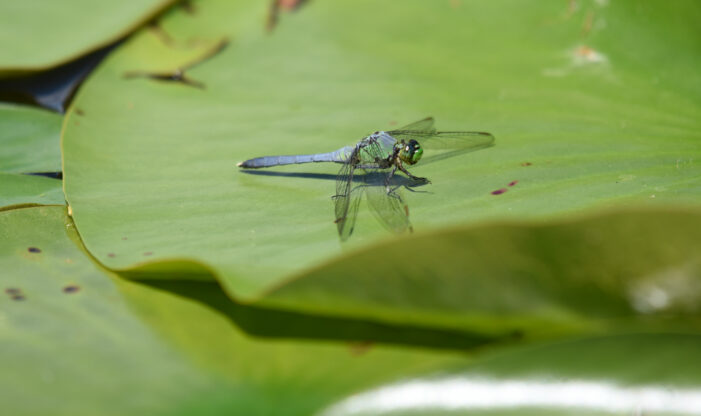
On a late summer stroll along a slow-moving stream or small pond, you may spot a shimmering insect zipping past at startling speed. As it pauses to rest on a blade of grass and bask in the sun’s warm rays, you marvel at its iridescent wings spread wide and flat atop its large body of vibrant green and blue. A black bullseye marking in front of its enormous, green-tinted compound eyes gives a clue to its family. This is one of Wisconsin’s largest dragonflies: the spectacular green darner (Anax junius). While both sexes share signature green hues, females can be distinguished by their greenish-red thorax and brown abdomen, contrasting with the male’s vivid lime-green thorax and pale blue abdomen.
To fully appreciate the green darner, you must first meet its kin. The name “darner” likely traces back to old European folklore labeling them the “devil’s darning needles,” perhaps inspired by their needle-like tails and how they slice through the air in stitching-like motions to capture their prey with deadly accuracy. Though these powerful insects of the family Aeschnidae can be found globally, you may encounter several relatives of the green darner locally: the variable darner adorned by thin blue stripes across its abdomen or the blue-eyed darner distinguished by its brown and blue abdomen accompanied by a striking azure face.
Here in Southeastern Wisconsin, green darners typically appear as early as midApril and stay through September, the first and most enduring dragonfly species of our warmer months. In spring, they frequent the Center’s Maple Grove as well as Teal Pond, Dragonfly Pond, and Turtle Pond. By summer and early fall, they grace all our ponds, though preferring those without fish, which are voracious predators of dragonflies in both their nymph (larvae) and adult forms. As a result, you may observe fewer dragonflies flitting around the lily pads of Mystery Lake compared to our other ponds.
The presence of dragonflies in aquatic habitats ties directly to their life cycle—in fact, green darners spend most of their lives underwater! Like all dragonflies, they undergo three developmental stages: egg, nymph, and adult. Mating begins in flight, with the male grasping the female behind her head using specialized claspers at the tip of his abdomen, forming a tandem pair. Together, they land on plants near the water’s edge, where the female dips her abdomen below the surface to pierce stems or sediment with her ovipositor, carefully inserting eggs into the protective tissue.
Once eggs mature, the nymphs hatch and live underwater for either a single season or up to three years, sometimes molting over a dozen times as they grow. The speed of their development depends on the length of days (known as photoperiod) and the temperatures they’re exposed to as eggs and early nymphs. Migratory populations experience accelerated development over a single season while resident populations develop more slowly, entering diapause as nymphs during the colder months until warm weather returns. When ready to metamorphosize, they crawl onto supports like above-water plant stems or rocks and shed their exoskeleton one final time to emerge as winged adults. This adult phase is remarkably brief, lasting only six to eight weeks—inviting us to appreciate the ephemeral sight of these impressive aerial dancers all the more.
Perhaps the most awe-inspiring aspect of the green darner is its multi-generational migration. Two decades of data collection by experts and citizen scientists reveal that populations journey up to 1,500 miles across Canada, the United States, and Mexico over three generations: the first ventures north in the spring, the second goes south in the fall, the third stays in the southern part of their range over winter, and the cycle restarts. Migration bolsters their resilience as a species because it spreads their reproductive efforts across many distant water bodies, ensuring that pockets of their population survive even if others are impacted by drought, predation, and high competition. Findings suggest that temperature thresholds each season trigger migration, among other potential factors still unknown. Researchers emphasize that many mysteries remain when it comes to insect migration, including what their precise migration routes are along the coasts and through the Midwest.
As we watch green darners zig zag and swoop over our ponds and marshes during their short adult lives, the secrets of where they came from and where they will go only add to their magic.
Staff Contributions:
Alison Schrad, Environmental Educator
Melanie Ziolecki, Environmental Educator
Sources:
Dragonflies of North America by Ed Lam, October 2024
Dragonflies of the North Woods by Kurt Mead, August 2022
Dragonflies & Damselflies: A Folding Pocket Guide by James R. Kavanagh, March 2009
Tracking Dragons: Stable Isotopes Reveal the Annual Cycle of a Long-Distance Migratory Insect by Michael T. Hallworth, December 2018