
With Contributions from AJ Grill, Associate Director of Education
The Center’s ponds are brimming with activity, more than you might realize! If you peer into the water, you’ll see a living mosaic in motion: tiny specks darting in jerky bursts, threadlike bodies wriggling in S-shapes, beetles tracing wild circles, and alien-looking forms clinging to mucky sticks. Together they create a fascinating choreography across and below the water’s surface. These organisms, called aquatic macroinvertebrates, aren’t just mesmerizing to watch—they also offer scientific insights into the health of the entire pond ecosystem.
Aquatic macroinvertebrates are water-dwelling animals without backbones that are large enough to see with the naked eye. Instead of internal skeletons, they rely on exoskeletons made of chitin for structure and protection. Though incredibly diverse, the macroinvertebrates in the Center’s ponds can be grouped into three main categories: insects, crustaceans, and mollusks.
Insects in their various forms make up a large portion of pond life. Many spend their early life stages underwater before emerging as winged adults. As master builders, caddisfly larvae construct protective, tube-like cases around themselves from pebbles or plant debris: a perfectly camouflaged shelter. Dragonfly nymphs are fierce predators that live in the water for two years, growing larger and more formidable before breaking out of their exoskeleton and taking to the skies. They use their extendable lower jaw to snatch up unsuspecting prey. Another hunter of the pond, the predacious diving beetle eats tadpoles and even fairy shrimp in its larval form. As adults, they dive with an air bubble tucked beneath their outer wings like a tiny scuba tank.
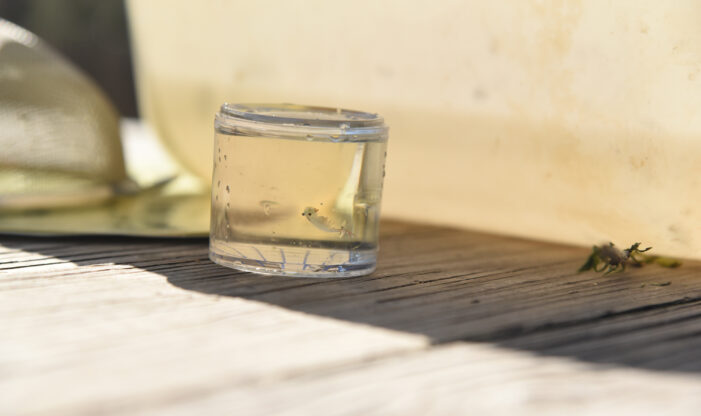
Crustaceans bring a different set of shapes and movements. Scuds, also known as amphipods, are small and shrimp-like, often seen swimming on their sides in quick, twitchy motions. Daphnia, also aptly named “water fleas,” are even smaller, bouncing through the water with jerky movements powered by their antennae. Among the pond’s most enchanting residents, fairy shrimp swim by waving their delicate, gill-like legs as if strumming a harp. Remarkably, their eggs can remain dormant for decades, sometimes up to a century, waiting for the right conditions to hatch.
Mollusks draw less attention with their slower, sometimes very minimal movements. Fingernail clams, named for their tiny size, use their hard shells attached by strong muscles for protection as they filter water for food. Also in this group, the pouch snail crawls upside down on the water’s surface, gathering air into its shell for breathing underwater.
Beyond their captivating behaviors, macroinvertebrates help signal water quality. Scientists and land managers use them as bio-indicators: species that are highly sensitive to environmental stressors such as pollution or sudden shifts in temperature caused by climate change. Some species, like caddisfly larvae and daphnia, require clean, well-oxygenated water to survive. Their presence suggests a particularly healthy ecosystem. An intervention may be needed if only highly pollution tolerant species are in a water body. Macroinvertebrates’ abundance, varied sensitivity, and ease of collection make them excellent early detectors of ecosystem degradation.
Sampling macroinvertebrates can be surprisingly simple, though a little messy. Using a strainer, bucket, spoon, and identification guide, researchers and citizen scientists gently scoop through the pond, swishing water and mud to capture these small, wriggling critters. Once collected and identified, an overall water quality rating is calculated using a well researched formula with inputs based on each species’ abundance and established pollution sensitivity score.
Importantly, this data doesn’t stand alone. It complements other measures like water chemistry testing, turbidity (clarity) assessments, and plant and wildlife surveys. Together, these approaches create a more complete understanding of the ecosystem.
Macroinvertebrates are also an essential building block of the pond’s food web. They provide nourishment for frogs, turtles, ducks, fish, and mammals like muskrats. Even within their own category, they form a layered food chain: smaller species like insect larvae and worms are eaten by larger ones like crayfish, which in turn become prey for birds such as Great Blue Herons. Without a thriving community of macroinvertebrates, the entire pond ecosystem would collapse.
Next time you visit our ponds, lay on the boardwalk and observe the water. Watch for the quick flick of a scud, the drifting glide of a larva, or the sudden dart of a tiny predator. With a little focus, you can identify some of these remarkable creatures for yourself.