

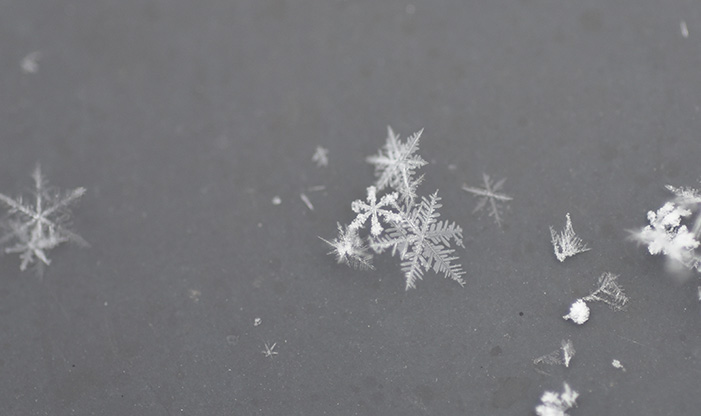
No two snowflakes are exactly the same. If you have ever captured one on your mitten and looked at it closely, the crystalline structures can tell you about its journey and why it looks different than other snowflakes.
It all starts with a dust particle in a cloud. The water in the cloud begins to condense on that particle, and from there, the snowflake begins to form. Every snowflake will take on a hexagonal shape due to the molecular structure of water, but the final shape can vary depending on the environmental conditions as it develops.
There are 121 different types of snowflakes that fall into eight categories: stellar dendrites, needles and columns, capped columns, fernlike stellar dendrites, diamond dust crystals, triangular crystals, twelve-branched snowflakes, and rimmed snowflakes and graupel. As each snowflake travels its own path through the clouds, the unique temperature and humidity along the way determine its growth structure.
When the temperature is just below freezing, a hexagonal plate begins to form. If the humidity remains low as the snowflake falls, it keeps this shape. With more water in the air, the snowflake is able to grow branches and form dendrites from the six points of the plate. This is the shape people are most familiar with.
All the dendrites start as a stellar dendrite, but if the snowflake has more time in the clouds and encounters more moisture, it can grow smaller sidebranches, resembling a fern. Smaller dendrites fall when the temperature is just below freezing, whereas larger dendrites make an appearance when the temperature is around 5° Fahrenheit and humidity is high.
Between 23 to 14° Fahrenheit, snowflakes can form into needles and columns. These columns have much of the same shape as a standard No. 2 pencil. Sometimes these columns are hollow and sometimes, if the temperature cools to 21° Fahrenheit or below while they’re forming, they become capped as plates grow on the ends.
Collisions in the clouds can create different types of shapes. When two dendrites clash into each other, they form a twelve-branched snowflake. If small droplets of water, called rime, clash into a snowflake and freeze onto the surface, it creates a form called graupel. Often mistaken for true hail, which is a solid piece of ice, graupel is sometimes referred to as soft hail because it breaks apart easily.
No matter what snowflakes look like, once they reach the ground, they provide us with an abundance of recreational activities like snowshoeing or sledding down your neighborhood hill. Next time you enjoy a fresh snowfall, catch a few flakes to find clues about their journeys through the clouds!