
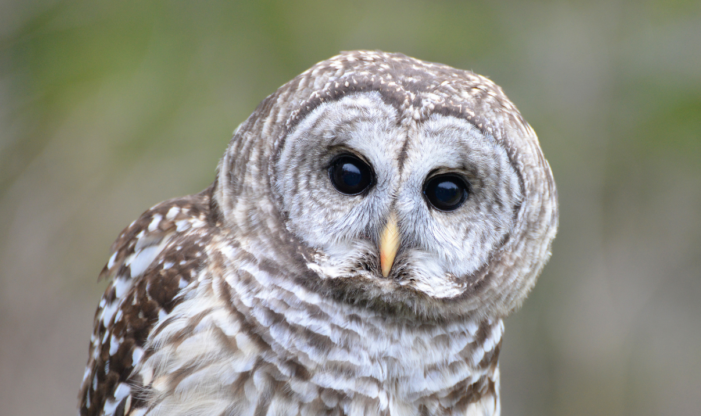
In June 2018, the Raptors of Schlitz Audubon received a thrilling note from our colleague Dianne Moller, the Executive Director and Raptor Rehabilitator at Hoo’s Woods Raptor Center. She had a young, non-releasable Barred Owl in her care that was a great candidate for education, and she wondered if we would be interested in welcoming this owlet into our program. We gave an enthusiastic ‘Yes!’ and the owl found her forever home at Schlitz Audubon.
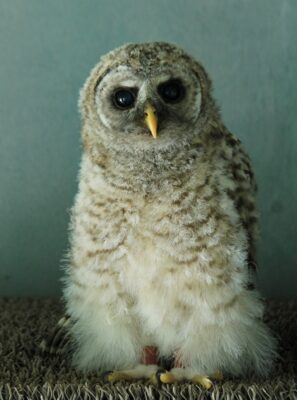 At merely two months old, the little owl was still covered in fluffy down feathers and beheld everything she saw with curiosity in her large, dark eyes. How does a bird so young find its way into wildlife rehab with a need for permanent care? When she was just a few weeks old, she fell out of her nest. A strong windstorm or even a misstep can cause a bird to prematurely find itself on the ground below. Like humans, it’s not uncommon for baby animals to get into precarious situations, but usually mom and dad are nearby to protect and care for them. When this happens to owlets, in most cases their parents will continue bringing food and, when developed enough, the young one may even find its way back up the tree.
Our little owl’s nest tree was located in a busy public park, and when on the ground, she quickly drew the attention of people passing by. Rather than realizing she was an animal in distress and in need of help from experts, a few people decided to interact with her. Though their motivation to hold the baby owl may have been innocent, the owlet’s parents stopped caring for her due to the humans’ presence. By the time Hoo’s Woods was contacted, rescued her, and took her to their hospital, she was emaciated. Moller also noticed that the owlet was extremely comfortable with her and exhibited food begging around her, a behavior reserved for mom and dad. Due to human interactions for nearly two weeks, the bird imprinted on people and sought out their companionship and care. As a result, she could no longer be safely released back into the wild.
Settling in at Schlitz Audubon
Once the owlet arrived at Schlitz Audubon, we had the fun task of choosing the perfect name. At the time, we had another Barred Owl named Orion and hoped to keep the celestial theme tied to this species. Barred Owls are nocturnal hunters, so the association of constellations with their presence is fitting. When the name was suggested, it clicked immediately: this is Perseus. The mythological being was a warrior and protector who fought evil. Perseus also prevailed over Medusa, a fitting parallel as snakes are often found on a Barred Owl’s dinner plate. Once she had a proper name, it was time to work on training.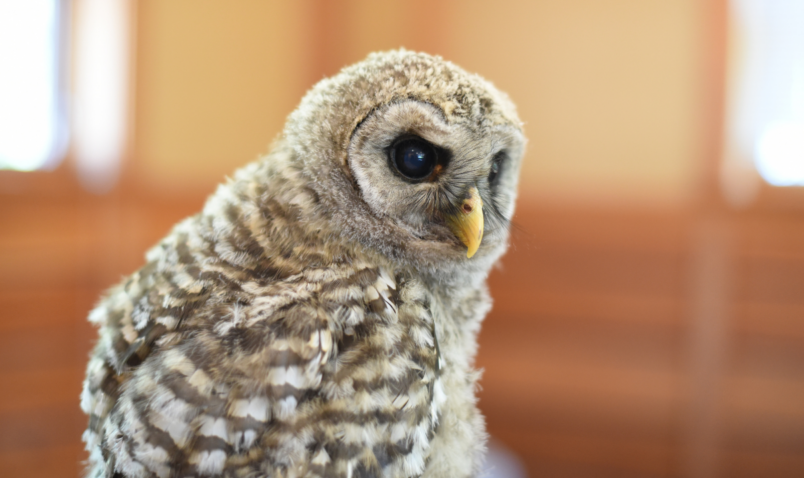
When a young bird joins our feathered family, they have a lot to learn about being an ambassador for their species. Training progresses at the speed of each bird’s comfort and confidence. Due to her ease with caretakers, Perseus succeeded quickly. By that fall, she was meeting the public in our educational programs, perched proudly on a handler’s glove!
An Amazing Owl Ambassador
Barred Owls are native to Wisconsin and found throughout the state. They are less abundant than other owl species, making it particularly special to encounter one in the wild. They prefer to live around wetlands, swamps, and marshes, where they can catch fish and crayfish, although their diet is variable and includes mammals, small birds, reptiles, and amphibians. Like a flamingo whose pink coloration comes from eating algae and brine shrimp, Barred Owl feathers can show a pink hue from eating crayfish!
Their loud and dominant call sounds like ‘who cooks for you’, although they exhibit a complex variety of vocalizations. A high-pitched begging whistle is used by young chicks or between mated pairs. Soft, single syllable ‘hoo hoo hoo’s are heard during breeding season around the nest cavity. When overly excited, the owls will belt out loud ‘wha wha wha’s that are often compared to the barks of dogs or primates. During our educational programs, Perseus often announces her presence by hooting out ‘who cooks for you’ while waiting in her travel crate. Behind the scenes, as an adult, she still uses her high-pitched whistle call in excitement when she sees her caretakers.
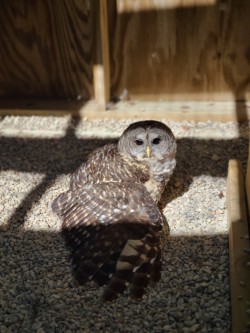 Between her educational programs, Perseus knows how to relax. When the afternoon sun hits, she’s been found lying down on the ground with her wings out, often face down, sunbathing in the warmth. This sight immediately brings panic to her caretakers until she lazily raises her head and looks up with squinted eyes, wondering what all the fuss is about.
Through our educational programs, Perseus teaches people of all ages about this often-unseen hunter of the sky. Participants observe how large and dark her eyes are, the perfect camouflage of her feathers, and the multitude of other adaptations that make owls some of the most successful in the animal kingdom. In 2025 alone, Perseus met over 21,000 curious onlookers! She visits with our onsite Nature School kids, travels to retirement communities, awes Wisconsin State Fair attendees, and has enjoyed visits to American Family Field for their Harry Potter theme night.
The Role of Rehabilitators
Perseus serves as a reminder to seek out a wildlife rehabilitator if you find injured or sick wildlife. Rehabbers are trained professionals with the necessary permits, licenses, knowledge, and skills to care for our wild friends. When young birds fall from the nest, they can often be put back in or, in some cases, placed with a wild foster family. Recently in the Milwaukee area, an owl nest was completely destroyed, leaving the owlets on the ground. A licensed professional created and mounted an artificial nest in a nearby tree for the owlets, and the parents continued to care for their babies. In cases with orphaned birds, rehabbers may find another nest with young of similar ages, often allowing the bird to be raised naturally by parents from its species. Perseus encourages everyone to call their local wildlife rehabilitator to help these animals.
Meet Perseus & Other Owls
If you’d like to meet Perseus, or any of our owl ambassadors, we invite you to attend one of our Owl Prowls in the fall. Our owl ambassadors meet with attendees up close and show them the different species they may encounter on our prowls. Our October Raptor Saturday (held on the first Saturday in October) is also one of our most popular. This one-hour program about Wisconsin Owls features all of our owl ambassadors. Also keep an eye on our Raptor Encounter schedule, as Perseus occasionally makes appearances during this informal meet-and-greet style experience hosted on the weekends. We are grateful to care for this beautiful and confident Barred Owl and honored to share her with our community!