
With contributions from Fiethong (Fie) Thao, Restoration Ecologist
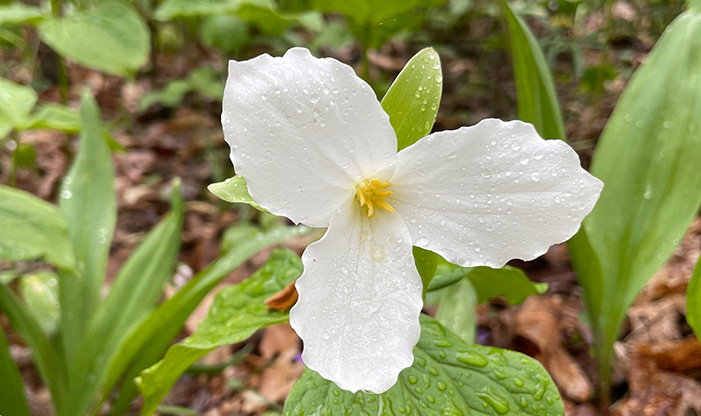
As Wisconsin’s forests wake up, trilliums quietly emerge in April through May as some of the most beloved and easy-to-recognize spring ephemerals. Their beauty is subtle but unmistakable, and their name offers a clue for identification: “Tri” means three. Each plant sends up a single stem topped with three green leaf-like bracts, supporting a flower with three petals and three sepals underneath.
Trilliums of Wisconsin
Six of the United States’ 38 trillium species are native to Wisconsin: the giant white trillium (Trillium grandiflorum), nodding trillium (T. cernuum), snow trillium (T. nivale), prairie trillium (T. recurvatum), red trillium (T. erectum), and nodding wakerobin (T. flexipes).
Botanists divide trilliums into two main groups. Pedicellate trilliums have flowers held above the bracts on a short stalk called a pedicel, while in sessile trilliums the flower rests directly on top of the bracts.
Schlitz Audubon is home to three species: great white trillium, nodding trillium, and prairie trillium. The great white trillium is the most familiar and widespread, boasting the largest flowers at about two to three inches across. Interestingly, its stark white blossom fades to pale pink in its final days. Nodding trilliums live up to their name, with a smaller white flower that droops downward on a curved stalk (the pedicel), sometimes hiding beneath the bracts. Unlike the others, the prairie trillium is sessile with a deep wine-red flower sat atop mottled green bracts. The Center’s trilliums thrive in the high-quality forest habitats of our bluffs and ravines near the Pavilion and along the Lake Terrace Loop. Our Land Stewardship Team regularly removes invasive species like buckthorn to maintain their population and open new areas for potential growth.
Reproduction
Trilliums reproduce both asexually through rhizomes and sexually through seeds. Underground rhizomes, which resemble knobby brown stems, spread from the parent plant to put down roots and send up new shoots. Reproduction through seeds requires help from pollinators such as bumblebees, flies, and wasps. Some species, including red trillium, emit an unpleasant odor compared to rotting flesh, which attracts pollinating flies.
Once seeds are produced, ants play a crucial role in dispersal. Each seed carries a fatty appendage called an elaiosome that ants collect for food, later discarding the seed in their colony’s nutrient-rich dump. Germination can take two to three years, and it may take seven to ten years before a trillium produces its first flower!
Why Trilliums Matter
These plants have long held significance among Native American medicine women, who used them to support reproductive health and ease childbirth. Ecologically, they are powerful indicators of ecosystem health with their slow life cycle and reliance on specific site conditions.
As you wander the spring forest, keep an eye out for the showy blooms of great white trilliums, the smaller maroon flash of prairie trilliums, and the easily overlooked nodding trilliums. When you consider the years of growth, hard work of insects, and careful stewardship by humans, a single trillium bloom feels like the triumph of a healthy ecosystem.