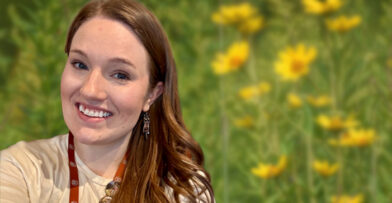

With contributions from Abbey Finn, Early Childhood Educator & Artist in Residence
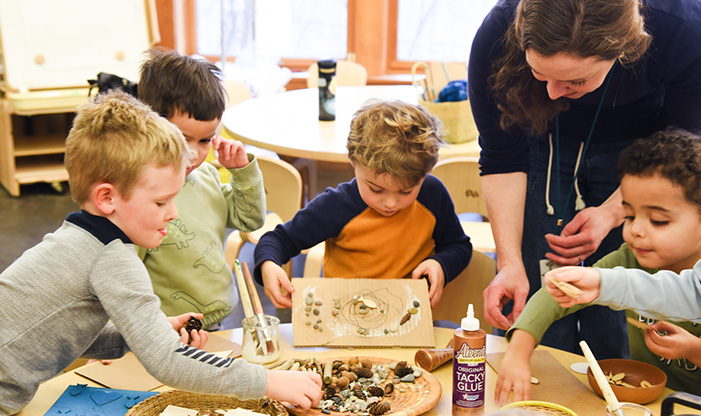
In early childhood education, art is far more than a finished product to hang on a wall. It’s a way of thinking, observing, experimenting, and expressing. At our Nature School, art making is woven into the rhythm of each week. Through painting, weaving, sculpting, and printmaking, young learners deepen their relationship with the natural world around them, developing key skills along the way.
Nature serves as both inspiration and material. Children might paint the forest’s dynamic hues, document pond life through nature journaling, or explore texture using elements gathered with intention and reverence. Repurposed wood slices from fallen ash trees, beach stones selected sparingly, and other carefully sourced items teach children that creativity and care for the land can coexist. With such a strong emphasis on place, process, and purposeful use of materials, drawing inspiration for Nature School projects from beloved local artist Mary Nohl was a natural fit.
The idea took shape through Abbey Finn, now in her second year as the Nature School’s Artist in Residence. Art has long been part of the program, with teachers regularly offering open-ended invitations to create. Finn’s background in art education has allowed the school to take art making a step further, designing more comprehensive projects with broader exploration of different mediums for all 11 classes.
Finn’s own connection to Mary Nohl began in childhood, when she heard stories about the lakefront property which was then referred to as the “witch’s house.” Those narratives, shaped by misconceptions and rumors, lingered in community memory. As she grew older and learned more about Nohl’s life and work, a deeper understanding emerged. Nohl was an extraordinarily inventive, self-possessed, and social artist who mastered a wide range of materials. She filled her home and yard with astounding artworks, creating an immersive and ever-changing space from her own imagination. Her full-time residence from the 1960s to her passing in 2001, the Mary Nohl House featured 59 fantastical concrete sculptures, many incorporating sand and stone gathered from the nearby Lake Michigan beach. She built them herself, relying on her own two hands and driven by a tireless curiosity about how things could be made.
Inspired by a tour of the site led by Alex Gartelmann, Mary Nohl Program Director and Site Steward, Finn recognized how seamlessly Nohl’s artwork and approach connect with the Nature School. Both are rooted in the same landscape. Nohl lived and worked on the lake; Nature School children hike its trails, listen to its waves, and feel it’s changing moods. Moreover, many Nature School families live in the North Shore, making that sense of place even more personal. Nohl often used found materials, recycling and reimagining what others overlooked. That spirit of resourcefulness and imagination mirrors the school’s values.
The Nature School’s second annual Art Show displays various projects inspired by Nohl in the Center’s Art Gallery this April. Some pieces respond to the same surroundings that influenced her. Students created Lake Michigan-inspired wet-felted pieces and weavings, translating the water’s movement and color into fiber. After pausing to consider its waves, children also created process paintings to capture the lake’s personality, whether it was calm and glassy or big and crashing. Other projects drew more directly from Nohl’s forms and materials. Children crafted cement stepping stones embedded with beach treasures, emulating Nohl’s shoreline sculptures. They also sculpted imaginative mini creatures with varied textures, incorporating stones, driftwood, and sand. Finn carefully planned each project to ensure it was age-appropriate, fun, and enriching for young children.
The benefits of these projects extend beyond creativity. The tactile experiences strengthen fine motor skills, developing the small muscles in children’s hands that are essential for learning to write. Weaving, pressing, sculpting, and embedding objects builds dexterity and coordination. At the same time, learning about Nohl’s story offers important social-emotional lessons. The outdated “witch” narrative surrounding her home became an opportunity to discuss curiosity and empathy— a reminder not to judge someone without truly knowing them.
Every student is exhibiting a piece, filling the Center’s Art Gallery with an array of colors, textures, and interpretations. As children proudly guided family and friends through their work on opening night, they echoed Mary Nohl’s own love of sharing what she made. In doing so, they remind us that art is not only about what we create, but about the connections we build— to the land, to one another, and to the stories that shape our community.
Visit our Art Gallery April 9 through May 1 to see the Nature School Art Show for yourself!