
In 2025, we launched our Barred Owl nest box livestream, and the public fell in love with the wild owl family on their screens. A camera mounted in the box provided an up-close glimpse into their story—from egg laying to first flights. We watched as the owl couple successfully raised two male owlets: one who was very brave and left the nest quickly and the other who needed more coaxing. Both young owls were observed in the area after leaving the nest and were last seen in August when they set off to explore the world independently.
We received comments that classrooms, libraries, and workplaces were streaming the box! We were elated at the opportunity to interact with livestream viewers on our social media pages, answering questions about what people were seeing and celebrating collectively when the two owlets took flight. This wasn’t the owl couple’s first successful mating season—in fact, the project started years ago.
Project History
In the fall of 2021, two Barred Owls moved onto a private property in the Milwaukee area— an opportunity to gain new insights into these feathered forest-dwellers! I, the Raptor Program Director, contacted Dr. Bill Stout, a licensed raptor bander and biologist who studies Cooper’s Hawk, Great Horned Owl, and Red-tailed Hawk populations in the Greater Milwaukee area. Together we sought to address gaps in existing research on land use and dispersal patterns of Barred Owls in urban settings. The goal of our new monitoring project was to answer these questions: Can Barred Owls adapt to human activities? How will their presence affect other raptor species’ land use in the area? What habitats and territory sizes are preferred during breeding and non-breeding seasons?
Joined by volunteers, our research team trapped and banded both owls. With the use of a black light on their flight (wing) feathers, we determined that both were approximately two years old. We named the male ‘Maverick’, as the young owl brazenly flew close over buildings and through the forest. ‘Betty’, the female, received her title after the passing of Betty White, a successful Hollywood star and strong advocate for animals and wildlife.
Next, our team installed a nest box on the property, and to our delight, Betty immediately flew into the box during mating season. The early stages of nest box monitoring involved a generously donated night vision camera, pointed at the box, which would record for only a few hours at a time. I then reviewed the footage daily and reset the camera for the next night. I watched excitedly as the tiny hatchlings developed flight feathers. When the owlets neared fledging, the process of a young bird learning to fly and leaving the nest, it was time to band them!
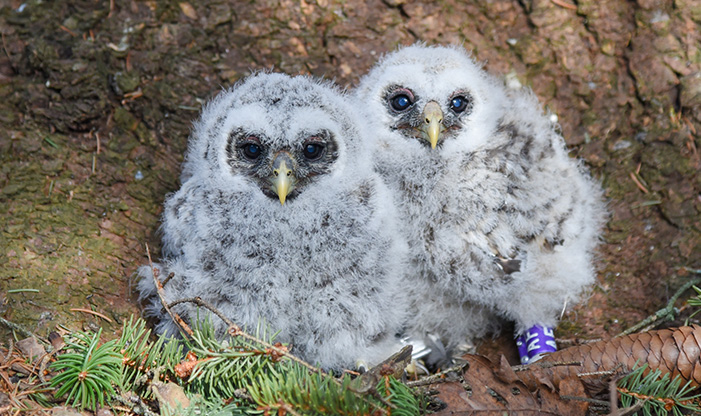
Dr. Stout carefully retrieved the young owls from the box and took measurements of wing length, weight, and collected other essential data. Like their parents, each one received two colored bands on their legs: one silver federal ID band and one purple project ID band. They were quickly returned to the box within minutes and Betty was soon back inside with them. ID numbers on the bands can be reported to the Bird Banding Lab with USGS and the location is shared with the bander. Any Barred Owl sporting a purple band in the Milwaukee area came from Betty and Maverick, and we encourage everyone to report these sightings. With this information, we can learn how far their offspring travel!
Since the first successful nesting season in 2023, Betty and Maverick have produced two to three offspring nearly every year!
Nesting Season
Betty and Maverick begin their annual courtship and nesting behaviors around December/January. This includes increased vocalizations between the two as well as routine checks of the nest box to ensure everything is in order. Betty begins ‘begging’ vocalizations (a higher pitched single note) to encourage Maverick to hunt for more food. She stops by the nest box, jumps in, and kicks up the substrate to create a small bowl to lay in.
As spring approaches, Betty visits the box more frequently and stays longer. On average, she lays the first eggs in mid-March. Eggs are laid in intervals, with two to four days between each egg. Incubation lasts for 28-32 days and the owlets often hatch in the order their eggs were laid in. As hatching approaches, Betty is often observed making quiet ‘clucking’ sounds to the eggs and, in response, the chicks can be heard chirping back to her (and to each other) from inside of their eggs!
Egg hatching starts with the ‘pip’: a small hole that appears on the egg which the young chick inside uses to take its first breaths. The new babies are covered in fluffy white down feathers and cannot thermoregulate (control their body temperatures) until approximately three weeks old. Until then, Betty must incubate them to keep them warm. Once they can stay warm on their own, Betty spends much more time outside of the box, coming in to feed the owlets and for occasional incubation.
After hatching, there are more hungry mouths to feed, and Maverick does most, if not all, of the hunting. He brings various prey to his family: small rodents, birds, fish, crayfish, and he has even snagged a few dragonflies. Maverick occasionally brings food directly to the box for Betty and the chicks, but also stays outside nearby and calls for her to come out to get it. Once the food has been delivered, Betty tears it into manageable pieces for the owlets. As they approach the four-week-old mark, she leaves the prey whole for them to swallow.
It’s also around this time when the research team carefully retrieves the owlets for measurements and banding. The data collected is essential for understanding the birds and their population over time. Each chick’s weight can inform the team if it’s a male or female (males are smaller while their sisters are bigger). Each receives its silver and purple bands, and then they are gently placed back into the box.
Fledging happens when the young owls are approximately five weeks old and often falls around Mother’s Day. Betty will stay outside the box during this time, enticing her babies to come out to join her. These first flights are very clumsy and often include a lot of falling, but the young ones climb up the trunks and branches of trees to get back up to mom. Both parents continue watching over their offspring, feeding them and encouraging them to fly greater distances. The babies also practice pouncing and other hunting skills so they can capture their own food. Barred Owl babies grow up quickly and, unlike Great Horned Owls whose young stay around into the fall, Barred Owls disperse from their parents’ home range by mid-to late summer. Betty and Maverick then get approximately five months to rest before starting again.
Through our Barred Owl Monitoring Project, we are learning about preferred habitat usage of urban owls, their diet, and nesting behavior and patterns. It enables us to collect a library of different vocalizations, study interspecies interactions with other neighborhood raptors, and bring the nest box livestream to our community, both local and more distant. Visit this page to learn about the project’s current status and tune in March through May to see the owls for yourself! We look forward to deepening our understanding and connection to these amazing birds through this project for each nesting season to come.