

West Meadows Stormwater Management Partnership
Schlitz Audubon is partnering with the Village of Bayside on their Shared Waters, Shared Future Stormwater Management Initiative, alongside the nearby Shul Center. Led by the Village, the project is designed to reduce stormwater influxes flowing from Brown Deer Road into Indian Creek, the Milwaukee River, and ultimately Lake Michigan.
As extreme rain events become more frequent, stormwater systems throughout the region are increasingly challenged. This partnership offers an opportunity to address that issue while supporting both the surrounding community and Schlitz Audubon’s conservation goals. By thoughtfully managing water on our property, we can help reduce pressure on nearby infrastructure while enhancing habitat, supporting wildlife, and creating new ways for visitors to learn from the land.
Implementation
The project focuses on capturing and then gradually releasing stormwater that falls on a 33-acre section of our property through a series of improvements primarily in the West Meadows. We are working closely with the Village of Bayside’s engineers and other project partners to ensure the design meets municipal stormwater goals while also aligning with our management plan for this part of the property.
Our portion of the project includes three main areas. Near the corner of Lake Drive and Brown Deer Road, a low-profile berm and control structure will help direct stormwater during major rain events, preventing flooding of the road. The structure will also protect and maintain the existing hydrology of our Hardwood Swamp Restoration area.
In the eastern side of the West Meadows, Gentian Pond will be expanded into a larger waterfowl pond with a berm and adjustable control structure. This will allow our Conservation Team to raise or lower water levels seasonally, creating favorable habitat conditions for different ducks and migrating birds.
The project team will create a new marsh habitat west of Gentian Pond, also within the West Meadows, which is currently dominated by dead ash trees and invasive buckthorn. They will dig a shallow pond with two small, open-water pools and construct a berm with a built-in control structure, allowing our Conservation Team to maintain the lower water levels required for this habitat type. To complete the marsh, the team will plant emergent sedges and grasses.
Together, these improvements will capture up to 490,000 gallons of stormwater and release it gradually over time, enhancing habitat quality while mitigating the negative impacts of stormwater influxes.
During construction, which is planned to start during the fall of 2026, the northern loop of the West Meadows trail will be closed. Once the project is completed, we will reroute this section of trail to connect visitors more directly with the pond and marsh habitat, including small foot bridges across overflow areas.
Community Benefits
This project will help reduce stormwater flowing into Bayside’s existing stormwater control infrastructure, freeing capacity to better serve nearby neighborhoods that have experienced major flooding in recent years. By capturing more water on Schlitz Audubon’s land and releasing it slowly, the project supports a broader community effort to manage heavy rain events more effectively.
As one of the largest nonresidential properties in Bayside, Schlitz Audubon is well positioned to contribute to a municipal-level solution. The project demonstrates how open space and natural areas can play an important role in community resilience, helping protect roads, neighborhoods, and waterways while enhancing habitat quality for resident and migrating wildlife.
Ecological Benefits
We are committed to establishing diverse and sustainable habitats. The project supports our overall goals for the West Meadows by reducing woody cover, increasing grassy and marshy habitat, and creating high-quality areas for birds and other wildlife.
The expanded waterfowl pond will allow our Conservation Team to manage water levels for different species and seasons. Lower water levels create mud flats where ducks feed, while higher water levels provide valuable stopover habitat for migrating waterfowl. In summer, the pond provides nursery habitat for Blue-winged Teals, who prefer to raise their young in open water near protective tall grasses.
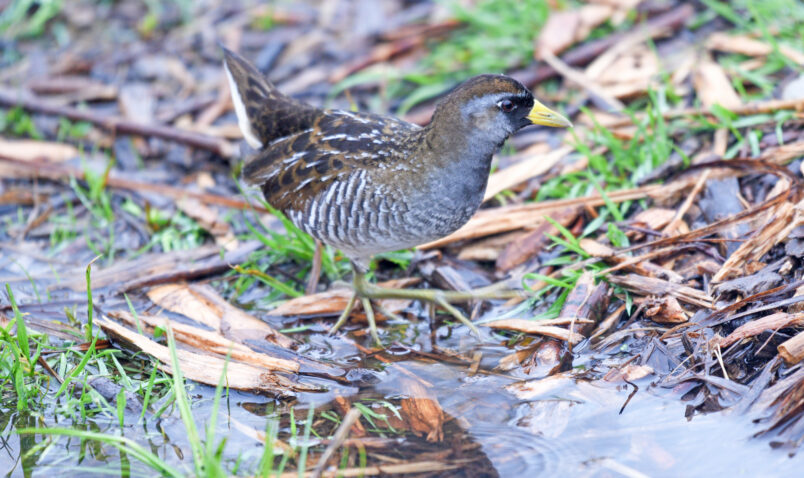
The shallow marsh will offer refuge for secretive birds, including soras, rails, and American Bitterns. Dense native vegetation and small pools of open water will provide cover and macroinvertebrate foraging areas, supporting a richer and more varied bird community.
By pairing stormwater management with habitat restoration, the project strengthens ecosystem services, increases wildlife diversity, and supports the long-term health of the Center’s Hardwood Swamp and West Meadows areas.
Educational Benefits
Our mission is rooted in connecting people with the natural world through meaningful experiences and environmental education. This project will establish new opportunities for visitors, students, and program participants to see conservation in action.
The restored pond and marsh will serve as outdoor classrooms where learners can observe how different birds use different habitat types. Visitors will be able to compare waterfowl using deeper pond habitat with marsh birds relying on shallow water and dense vegetation. The project will also help demonstrate how water levels can be managed to support wildlife, reduce invasive species, and respond to seasonal changes.
Our Conservation Team will work with our Environmental Education Team to incorporate the project into programs such as those offered through the Barbara Stover and Susan Bell Birding Academy. Through these experiences, participants will gain a deeper understanding of how land stewardship, stormwater management, and wildlife conservation are interconnected.
The West Meadows Stormwater Management Partnership is a powerful example of how thoughtful collaboration can benefit both the people and wildlife that rely on ecologically healthy and resilient habitats.