While bats are often the subject of vampiric lore and spooky stigmas, the realities of biology and ecology tell a very different, equally fascinating, story. In fact, we share more in common with these animals than you might think. As fellow mammals, they are warm-blooded, covered in hair, and nourish their young with milk. Far from being rare oddities, bats comprise 20% of mammals worldwide—totaling roughly 1,400 species!
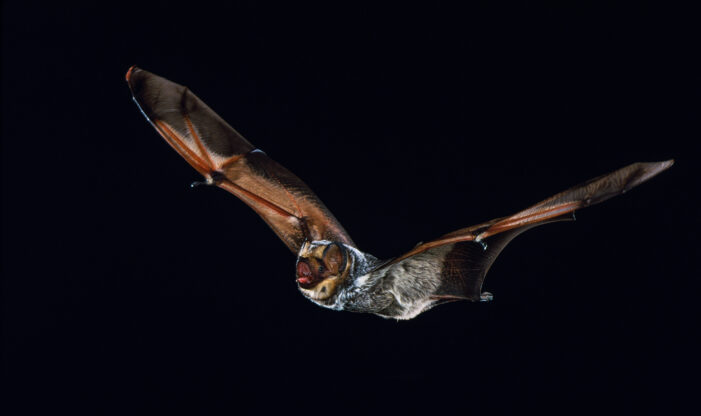
Yet for all these shared traits, bats possess one evolutionary marvel unmatched by any other mammal: the ability to sustain true flight. The skeletal structure of each wing is akin to our own hands, with five elongated fingers that they can move independently. Their fingers are connected by a thin and flexible membrane called the patagium. These unique wings allow them to achieve incredible control in the air; maneuvers like hovering in place, flying backwards, diving, and rolling serve them well in catching insects and escaping predators. Their thumbs have even adapted into hooks along the wing’s edge, aiding in climbing and handling food, while hanging upside down allows these skilled aerialists to launch into flight at a moment’s notice.
Wisconsin is home to eight bat species, all of which have been documented across Schlitz Audubon Nature Center’s extensive grounds. All members of the Vespertilionidae family, they are divided into tree bats and cave bats—a distinction that hints at where they spend their winters. Our native cave bats include the little brown, big brown, tricolored, and northern long eared, while our state’s tree bats are the silver-haired, eastern red, hoary, and evening. Beyond this broad grouping, these species vary significantly in appearance, reproduction, habitat preference, and vocalizations.
All of Wisconsin’s bats provide an array of ecological and human benefits thanks to their diet: insects. These small mammals have massive appetites, with a single bat capable of consuming thousands of wasps, moths, flies, and beetles every night. They are major predators of mosquitoes, which spread diseases like the West Nile Virus. By suppressing mosquito populations, bats directly reduce the risk of transmission to both humans and birds. They are also allies to farmers and forests, preying on crop pests like cucumber beetles and green stink bugs, as well as the invasive emerald ash borer, which devastates ash tree populations. As climate change creates more favorable conditions for mosquitoes and stresses agricultural systems, bats are important partners in climate adaptation.
Echolocation, paired with their agile flight, allows bats to pinpoint and capture their airborne prey with remarkable precision. While they are not blind, this ability helps them more effectively navigate and hunt at night—essential activities of their nocturnal lifestyle. Each species makes a signature ultrasonic clicking or buzzing noise typically above the range of human hearing. These sound waves strike nearby objects and insects, bouncing back to the bat’s sensitive ears. By detecting minute differences in the timing of these echoes, bats mentally map the distance, size, and direction of their surroundings. They increase their vocalizations when they need finer details, helping them snag their next meal.
Bats are most active during our warmer months, from April through early October, when bugs are abundant and water is readily available. They live in a variety of habitats; some prefer open grasslands, while others, such as the northern long-eared bat, favor forests. Regardless of their specific niche, all species share two essential needs: water—whether in streams, lakes, or ponds—and shelter for roosting, which can range from trees and rock crevices to man-made structures.
At the Center, our Conservation Team intentionally manages the land to meet these needs. To support the insect population, the team plants plenty of native species that produce nectar from spring through fall. They also maintain open water in our ponds by removing invasive plants and thinning dense growth—vital for both insect reproduction and bat hydration, as bats need about seven feet of clear space to dive for a drink. Furthermore, recognizing that trees are the primary roosting spots for Wisconsin’s bats, the team leaves approximately 20% of dead trees (snags) standing whenever tree removal is required for restoration projects.
As summer turns to fall and insects dwindle, bat species follow different avenues of survival: hibernation, migration, or both. Cave bats may migrate only a short distance to seek refuge in local caves and abandoned mines, where temperatures stay relatively consistent compared to freezing aboveground winter landscapes. There, they settle in—alone or in clusters—to begin their hibernation. They slip into torpor, a state where slowed metabolism, heartbeat, and breath allow them to ration their fat stores until spring feeding resumes. Tree bats, on the other hand, travel much further to southern states, or even as far south as Mexico (in the case of the hoary bat), where insects still buzz and flutter. If food availability or temperature dips, they may briefly enter torpor in tree cavities or under leaf litter to conserve their limited energy.
Sadly, over half of Wisconsin’s bat species are at risk. Big brown, little brown, northern long-eared, and tricolored bats are all listed as State Threatened; notably, the northern long-eared and tricolored bats are categorized as U.S. Endangered and U.S. Proposed Endangered, respectively. The silver-haired bat is designated as State Special Concern. Habitat loss and insecticide use threaten all species, while white-nose syndrome (WNS), a fungal disease that reached Wisconsin in 2014, has caused dramatic declines among cave-dwelling species. Bats are particularly vulnerable to rapid population declines due to their slow reproduction rates, with most giving birth to only one pup per year.
Research is key to informing actions that government agencies, organizations, and individuals can take to protect and restore bat populations. Schlitz Audubon partners with the Wisconsin DNR and U.S. Fish & Wildlife Service on their bat conservation programs to establish baseline population, location, and behavioral data from right here on our grounds.
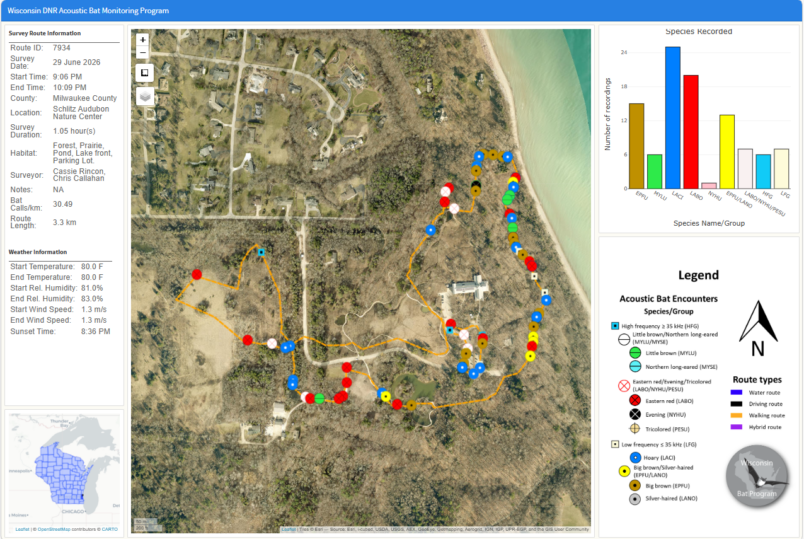
The WDNR-led Wisconsin Bat Program (WBP) tracks state bat populations through acoustic surveys and summer roost counts, both supported by a dedicated volunteer network. Schlitz Audubon contributes to this effort by documenting which species roost on our lakeside property. From June through July, staff walk a consistent trail route with an acoustic device, recording ultrasonic bat calls and their locations. We submit this data to the WBP team, who generate a cohesive species map, enriching their statewide data collection while offering Center staff insights into our resident bats. For example, 2026 data revealed our first ever documentation of an evening bat on the Schlitz Audubon property!
Complementary to the WBP effort and with support from the U.S. Fish & Wildlife Service, our Conservation Team monitors bats in our Hardwood Swamp restoration areas from spring through fall using passive acoustic recorder boxes mounted in trees. The devices collect nightly data on bat presence and absence, allowing us to track trends over time as the full impacts of our restoration work emerge. While it’s too soon to determine definitive results, our goal is to boost bat populations, particularly that of the northern long-eared, through habitat enhancements.
There’s much we can do individually and collectively to support these astounding, ecologically vital flying mammals. Bat Week, held at the end of each October, is an excellent opportunity to celebrate and educate about the importance of bats. You can take your action a step further by joining the WBP as a citizen scientist, building and installing a bat house, or planting native plants in your yard that attract calorie-rich insects like beetles and moths. Together, we can help Wisconsin’s bat populations rebound—and even thrive!
Featured photo by Merlin Tuttle, featuring a hoary bat in flight.
Staff Contributions:
Cassie Rincon, Environmental Educator
Drew Shuster, Director of Conservation & Land Management
Sources:
Institute of Environmental Research & Education
Wildlife Ecology & Damage Management
Wisconsin DNR – Wisconsin Bat Program
Wisconsin DNR – Bat Frequently Asked Questions