
In late January of 2000, a young family was spending a normal afternoon at home—before the day took an unexpected turn. They made lunch and packed up equipment for soccer practice as the car warmed up in the garage. When they went outside to leave, they were surprised to notice a young Red-tailed Hawk walking around their yard, tired, confused, and unable to fly. She wandered into the open garage and spotted a dog kennel sitting on the concrete floor. Without hesitation, she walked straight into the kennel and stayed, as though it was familiar to her.
Realizing the young bird needed help, the family contacted a nearby wildlife rehabilitation center. Rehabilitators discovered she was emaciated and dehydrated but thankfully had no broken bones or internal injuries. Essential nutrition and fluids brought her back to health, though she continued to show unnatural comfort with her human caretakers. Moreover, this hawk didn’t exhibit hunting skills or the ability to fend for herself. She was deemed a human imprint: a permanent condition which means she is ‘non-releasable’ and requires professional human care. The rehabilitators deduced from her behavior that other humans had previously kept her in a dog kennel.
At barely one year old, this juvenile raptor moved to Schlitz Audubon Nature Center. We had just constructed a new building to house our raptor ambassadors, and she became one of its first residents. Still recovering from her months of malnutrition, she was unable to fly and walked everywhere instead, inspiring her initial name: Walker. We gave Walker a large enclosure with sunlight, a bathing tub, a house to rest in, and perches that were connected by ramps to allow greater freedom of movement. As a year passed, Walker took her first flight. With wings outstretched, she flew from one end of the enclosure to another, earning a name upgrade: Sky Walker.
What Makes Red-tailed Hawks Special
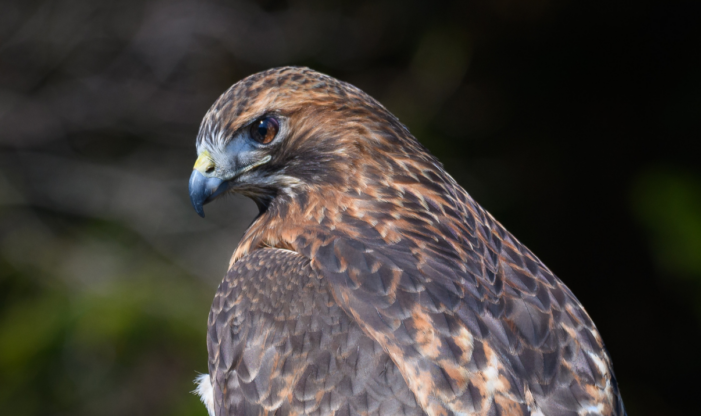
Having hatched in 1999, Sky Walker is the matriarch of our raptor ambassador family. In the wild, Red-tailed Hawks can live up to 15-20 years. They get their name from the cinnamon-red coloration of their tails that the sun illuminates into a lovely red as they soar through the sky. Immature hawks under the age of two have neutral light brown tails with dark bands, allowing raptor professionals and birders alike to estimate their age. When Sky Walker moved in with us, she still sported her immature plumage.
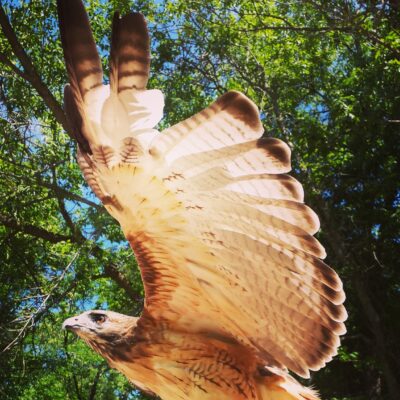 Red-tailed Hawks are one of the most common and widespread raptors in North America. As opportunistic hunters, their diet consists of many different types of prey, allowing them to adapt to whatever is most plentiful. As a result, they can comfortably live in a wide range of habitats: from grasslands to forests and from urban to rural areas. They mostly eat rodents but also hunt snakes, frogs, small birds, and even bats!
You can identify these large hawks by their tail plumage and the streaking pattern on their abdomen, referred to as a ‘belly band’. Some of the most common places to spot Red-tailed Hawks are on roadside trees or telephone poles. They utilize a ‘perch and pounce’ hunting method where they remain still on an elevated perch as they wait for prey to pass underneath. Mowing vegetation along roadways opens up the habitat, making it easier for raptors to spot a vole or squirrel from above.
A Seasoned Ambassador
In her important ambassador role, Sky Walker travels throughout the region to educate the public about this species that they may encounter in the wild. From preschool aged students to assisted living home residents, learners can fully appreciate the power of this successful hunter of the sky through these experiences. They can see just how big these birds are up close, with mighty talons and a beautiful, rusty-red tail.
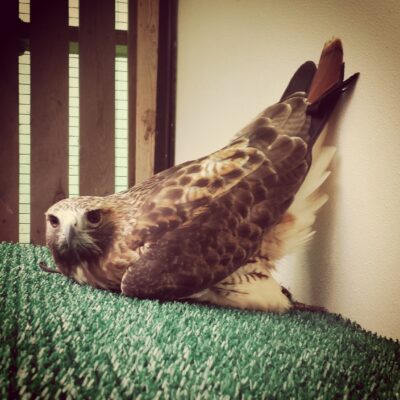 Between programing, Sky Walker is on constant watch at the Raptor Building. If a wild hawk flies overhead, she is the first to alert the rest of us with her high-pitched kee-ah scream, telling the passerby that this spot is taken. She occasionally lets down her guard to take a refreshing bath in her tub before resuming her post on top of a recovered ash tree perch, provided by our Conservation Team. As the summer days get warmer, Sky Walker basks in the heat. Each morning, her caretakers arrive to find her laying on the top of her house in a resting pose. In the bird management world, a bird laying keel (or breast) down is a sign of severe illness. For Sky Walker, it’s just her best chicken impression!
As our oldest and most experienced bird, Sky Walker continues to excel in her role as an ambassador. Although she once resided in the Center’s public Raptor Exhibit, threats of Avian Flu, West Nile Virus, and her own complications with advanced age have moved her back to the attentive care of her humans at our private raptor building. While she continues to attend educational programs, she has started to develop arthritis and mild cataracts. The quiet privacy behind-the-scenes allows for more relaxation where she can lay like a chicken and scream at all the wild hawks flying by, reminding everyone that she is our queen hawk.
You can meet Sky Walker at scheduled weekend Raptor Encounters or even consider a private Meet & Greet to spend some time with our magnificent matriarch.