
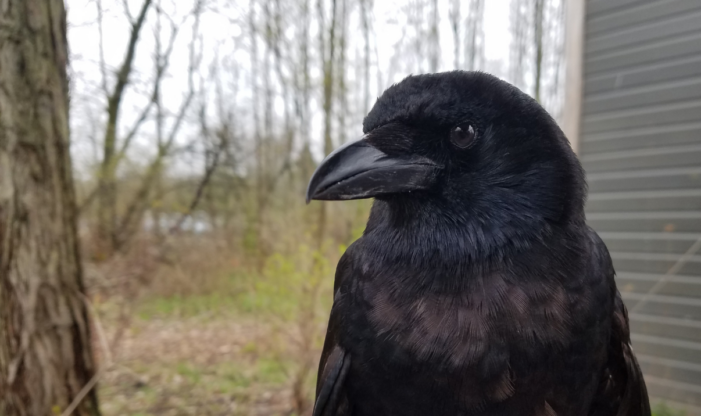
In January 2013, raptor staff walked into Milwaukee Mitchell International Airport to pick up a very special friend. In an office outside of baggage claim, we met Julie, a pilot for Southwest Airlines who also volunteered at the Lindsay Wildlife Museum in California. With much anticipation, Julie carefully opened the box she cradled in her arms, revealing a bird with sleek black feathers, a shiny long beak, and dark eyes that still held onto the faintest shade of juvenile blue. It was on that day that we welcomed the Program’s first American Crow, Loki.
Loki’s Early Years
As a very young bird, Loki was found in a neighborhood in central California. He was unable to fly and appeared quite sick. When he arrived at the rehabilitation center at the Lindsay Wildlife Museum, they feared he had West Nile Virus and treated him with fluids and the necessary medications. Over time, and with proper veterinary care, the young bird’s health greatly improved and he was moved to a socialization and exercise enclosure with other crows.
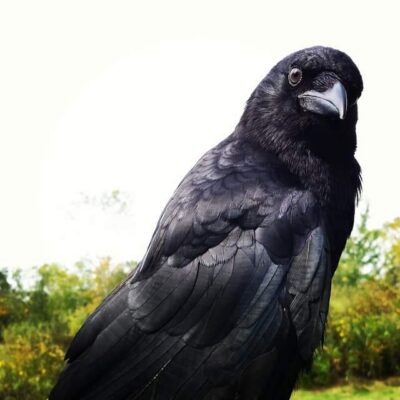 These birds are an extremely social species and survive in moderately sized family groups, but Loki quickly became distressed, hiding in the corner and afraid to interact with the others. In contrast, when his human caretakers came in for feeding or cleaning, Loki would run up to them with his wings bobbing in excitement and cawing for their attention. Naturally, wildlife should not exhibit such comfort towards people and seek out their companionship. When caretakers identified his behavior as that of a ‘human imprint’, they immediately removed him from the group and focused on looking after him separately.
But how could this have happened? When Loki was just a small chick, someone may have taken him from his nest in hopes of raising him as a pet. Stories have circulated of people raising sick crows and, after going free, the bird continuously returning to their home, flying with them as they drop their kids off at school or walk their dog through the neighborhood. This idea may motivate someone to take one from the wild. It’s important to note that these birds are protected by law and doing this is illegal. They are also extremely difficult to care for due to their high energy level and intelligence.
The person who did it learned just that: without proper care, the young crow became extremely ill. Rather than seeking help, the person simply placed Loki back outside. When the rehabilitators received him, he was extremely malnourished and lethargic, exhibiting symptoms that mimicked infection from West Nile Virus.
How Loki Found a New Home at Schlitz Audubon
In late 2012, our Schlitz Audubon Raptor team decided to add a crow to our program. It would be a first and, although our educational focus is on raptor ecology and conservation, a crow ambassador provides insight into the deep intelligence of birds through expressive and charismatic behavior. We sent out inquiries for a non-releasable corvid (crows and ravens) and received a reply from the Lindsay Wildlife Museum: they had a young American Crow who needed a new home. They estimated that he was nearly 3 years old and still showed some juvenile characteristics: food begging, a slightly pink mouth, and the smallest amount of blue in his eyes. Young crows have bright pink mouths to aid in feeding for their parents as well as soft blue eyes that turn dark as they reach maturity.
Julie, the volunteer from Lindsay Wildlife Museum, offered to bring Loki to Milwaukee on an upcoming flight. After the permit paperwork was approved, we met at the airport and welcomed our new crow!
During his first year with us, Loki was apprehensive and cautious. He was in a novel place with new feathered co-workers: a Great Horned Owl neighbor who hooted as the sun set and a hawk who constantly talked to all of his caretakers. There was a lot to learn and, with patience and through forming positive relationships, Loki soon realized that we all adored him and that he was safe.
Crow Intelligence
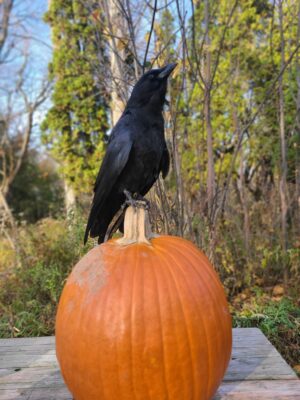 Crows are considered one of the most intelligent animals on the planet. Researchers have discovered that their brain synapses fire in the same way ours do, allowing them to problem solve, have incredible memories, and exhibit object permanence (knowing that an object exists even if they can’t see it). A famous study done in Washington showed that crows also exhibit facial recognition, meaning they can distinguish between different individuals based on appearance and associate experiences with that individual. They can even communicate this information about the individual to subsequent generations! This discovery was monumental in understanding animal intelligence, giving the term ‘bird brain’ a whole new meaning.
Crows’ social structure also mimics our own: they live in family groups of five to seven birds, with young from the previous nesting season sticking around to help raise this year’s clutch. In winter, all of these families converge to create a large flock of up to 40 to 60 birds. They have a language made up of varying caws and clucks to effectively communicate with each other about food sources, threats, and experiences.
Moreover, these resourceful birds can use and manipulate tools to achieve their desired result. For example, researchers have observed crows bending a branch to create a perfect hook to retrieve food from a small cavity. When it comes to crows, we have only scratched the surface on the full spectrum of their intelligence.
A Beloved Crow Ambassador
Loki shares these wonders with our visitors. At an astounding pace, Loki learned how to use his own tools: paintbrushes. With a specially designed brush held in his beak, he streaks paint onto a canvas to create truly unique art pieces. These paintings are used for fundraising events like our Gala and Xtreme Raptor Day, our annual raptor festival.
Our amazing crow ambassador also takes donations at large events like our presentations at the Wisconsin State Fair. Perched on his custom-made donation box, visitors can hand Loki their monetary donation and he puts it safely into the box. These contributions directly support Loki and the rest of the Raptors at Schlitz Audubon, while also providing him with great enjoyment from interacting with the public. Guests know him by name and now, as the years have passed, share their newfound appreciation of crows thanks to him.
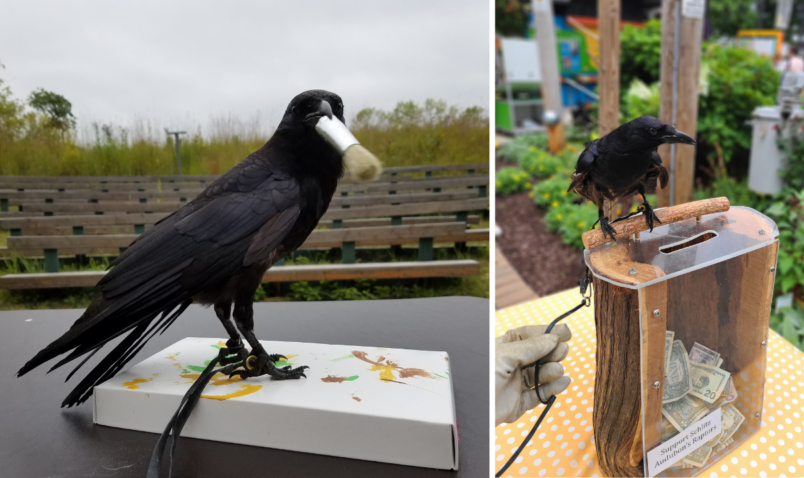
Between his jaunts in the public spotlight, Loki keeps his caretakers busy. He has an uncanny ability to solve puzzles and open boxes with hidden treasures inside. He often caws over us while we’re having conversations to ensure that we include him, which we invariably do. Every night, Loki sits on his perch and rings a bell, which always results in his caretakers bringing him one last peanut for the day. He has us all very well-trained!
In the early years of his time with us, many visitors were confused about why we had a crow in our program. The species is often seen as a nuisance or pest that flies through our neighborhoods eating our trash and harassing other birds. Loki works on changing that perception and showing everyone that we share our land with avian einsteins: birds that should not be scoffed at, but rather paid attention to. If you take a moment to watch what your neighborhood crow is doing, you can learn something every time. Although Loki is one of the smallest birds in our flock, he leaves one of the largest impressions on people, challenging our misconceptions of the charismatic and often misunderstood crow.