
In a small Milwaukee classroom, children sit attentively as a Raptor Educator describes the unique adaptations of raptors: forward facing eyes to aid in hunting, sharp talons to grab prey, and a hooked beak to tear food into bite-sized pieces. These traits help make raptors formidable hunters of stealth, power, and skill. The Educator then carefully brings out an ambassador and the kids gasp—and then giggle, unable to contain their excitement. The room fills with ‘awh’s as they are introduced to the Center’s smallest hunter: Willow, the Northern Saw-whet Owl.
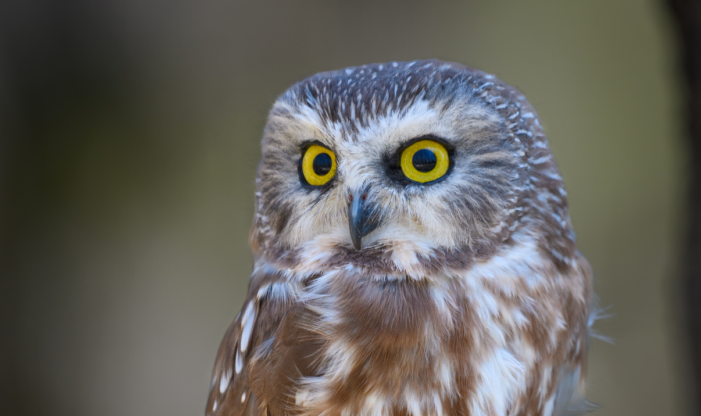
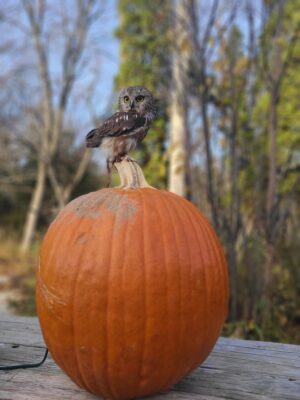 Very few birds illicit a more impactful response than our Willow. Weighing in at just 4 ounces and standing 6 inches tall, this little owl touches the hearts of everyone she meets. She found her role as an ambassador at Schlitz Audubon because our local community stepped up to help her.
In the fall of 2021, a couple was walking their dog in Shorewood when they came across this petite raptor on the sidewalk. Having some knowledge about wildlife, they decided to move her off the sidewalk and place her in a nearby bush, with plans to return later to check on her. When they did several hours later, they found her back on the sidewalk. With great care, they placed her in a secure cardboard box and brought her into their local wildlife rehabilitator, the Wisconsin Humane Society.
Once she was in the clinic, she underwent a full body exam with x-rays. The veterinarian discovered fractures in two of her bones which inhibited the use of her right wing. After getting surgery, her follow-up exams determined she was on the mend but would never regain her ability to fly. They found a forever home for her here at Schlitz Audubon, where she receives all the professional care she needs.
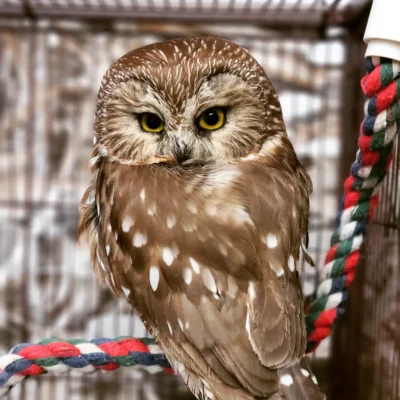 We were honored to welcome her into our educational program. Although injuries like hers can be difficult, we have the experience and resources to ensure all our raptors receive the appropriate accommodations. We gave her the name “Willow” for her soft stoicism and designed special housing that allows her to move freely without putting pressure on her wing. With an easy temperament, Willow quickly adjusted to her newfound limelight.
In 2025 alone, Willow met over 16,000 people through educational programs and community events. In classrooms, she helps teach students about owl adaptations like camouflage and silent flight. At events like the Wisconsin State Fair, she offers the public an up-close glimpse at this rarely seen bird. Everywhere she goes, she’s met with adoration and curiosity. Sitting calmly on a handler’s glove, Willow slowly looks around a room, turning her head so smoothly that some say she can’t be real! Large amber eyes seemingly take up half her head and her feet are often hidden beneath a thick layer of brown and tan feathers.
Rarely seen in Wisconsin, the Northern Saw-whet Owl is the smallest native owl species in our state. They nest here and sightings are most common in the fall months, as many migrate through from Canada. When considering owl vocalizations, many people think of the prominent ‘hoo hoo’ from a Great Horned Owl or the boisterous ‘who cooks for you’ from a Barred Owl. The tiny Saw-whet’s hoot gives them their name: a soft and high single-pitched ‘hoo’ that mimics the sound of a saw sharpened on a whetstone.
Even with their demure stature, Saw-whet Owls are fierce and calculated predators. This species hunts primarily small rodents like moles, voles, and shrews but also uses impressive maneuvering to capture small insects like moths. Yet they themselves are at risk of becoming a meal for larger predators. Luckily, these little birds have a trick up their sleeves: the coloration on the backs of their heads has evolved to resemble two large eyes. These ocelli, or eye spots, give the illusion that they are always watching, which helps protect them from potential threats. Insects, fish, and even tigers share this trait!
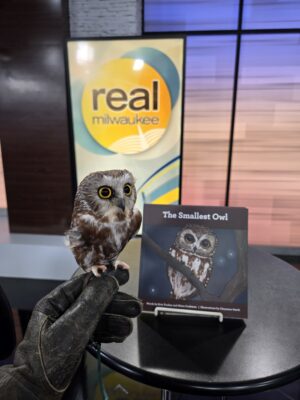 Not only is Willow an effective ambassador, she’s also the main character in her own book: The Smallest Owl. Written and illustrated by Schlitz Audubon Raptor Educators, the story follows Willow from the moment she was found on the sidewalk in Shorewood to her successful role as an ambassador here. You can find her beautiful and artful storybook in the Nature Store of our Visitor Center building.
If you hope to meet this charming owl, keep an eye on our calendar of events for her upcoming appearances. The Center hosts multiple Owl Prowls in the fall, where you can join Raptor Educators on a night hike to listen for wild owls and meet our owl ambassadors. You can also see Willow and our other resident birds at Xtreme Raptor Day in November, our annual festival celebrating these phenomenal hunters of the sky. Wherever the encounter, Willow leaves a lasting impression on everyone she meets and we are so grateful that she’s part of our feathered family.